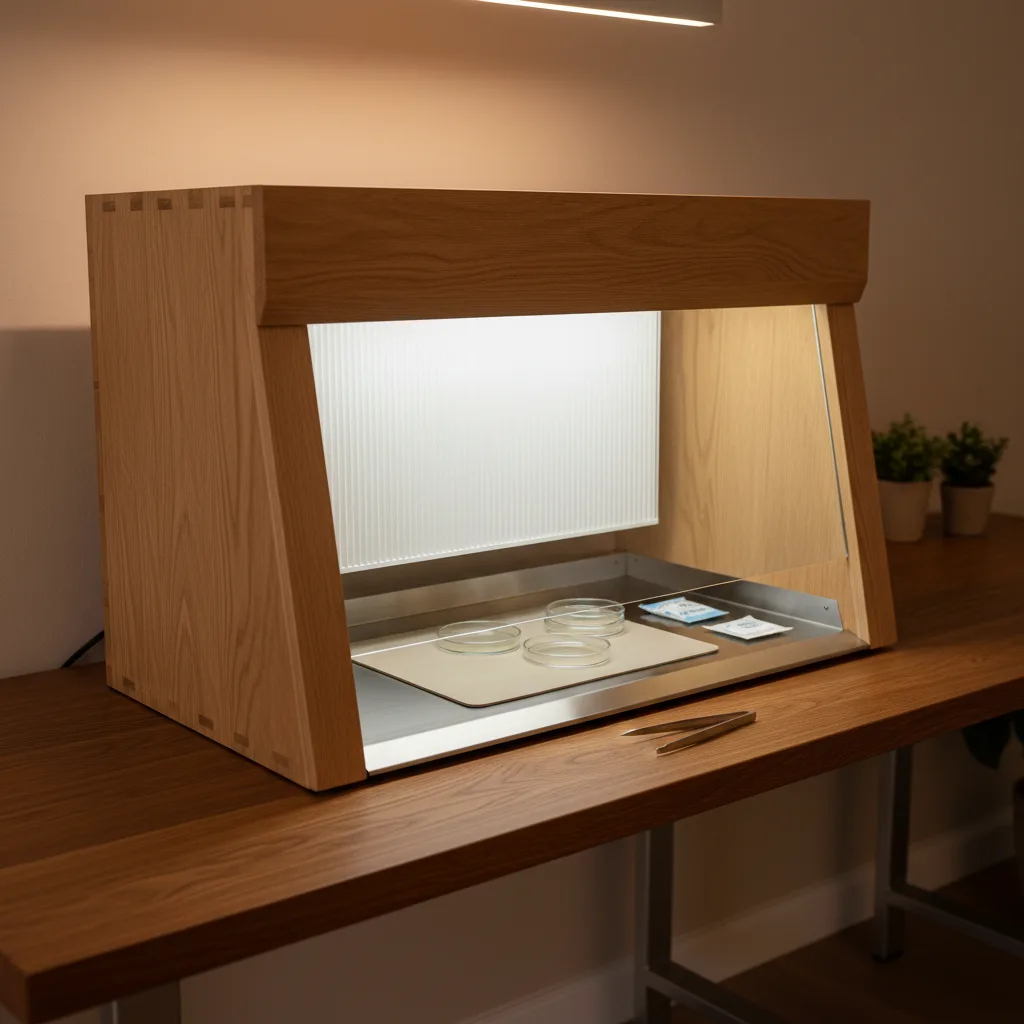
If contamination is the enemy of mushroom cultivation, then clean air is your best weapon. A laminar flow hood pushes HEPA-filtered air in a smooth, unidirectional stream across your workspace, creating an essentially sterile zone where you can do agar transfers, cloning, grain inoculation, and liquid culture work with dramatically lower contamination rates.
The difference between working in a still air box and working in front of a flow hood is like the difference between holding your breath and breathing freely. Both work. But one of them lets you relax, work at your own pace, and handle more complex procedures without the constant pressure of "every second this jar is open, contaminants are falling in."
We upgraded from a SAB to a flow hood about three years ago, and our contamination rate dropped from roughly 15% to under 2%. That alone paid for the equipment in saved grain and substrate within a few months.
Here's our honest assessment of the options available.
This post contains affiliate links. When you buy through our links, it supports our mycology work at no extra cost to you.
Quick Verdict
For most home growers, the Bonsai HEPAFLOW Compact hits the sweet spot of performance, size, and convenience. If you want a larger professional workspace and don't mind the investment, a full-size commercial flow hood like the 20"x15" H13 unit gives you room to work. And if you're handy and want to save significantly, a DIY build using a quality HEPA filter and blower gives you the most value per dollar.
Understanding Flow Hood Basics
Before comparing specific products, it's worth understanding what actually matters in a flow hood.
HEPA Filter Grade
HEPA filters are rated by their efficiency at capturing 0.3-micron particles (the most penetrating particle size). The grades you'll see in mycology:
- H13: Captures 99.95% of 0.3-micron particles. Excellent for mycology work.
- H14: Captures 99.995% of 0.3-micron particles. Lab-grade, overkill for most mycology but nice to have.
- H12: Captures 99.5%. Adequate but on the low end.
For mushroom cultivation, H13 is the practical minimum. H14 is better but costs more. H12 works but you're leaving more margin for error.
Airflow Speed
You want approximately 30-45 metres per minute (100-150 feet per minute) of air velocity at the work surface. Too slow and you don't get effective contamination protection. Too fast and you start drying out your agar and creating turbulence.
Horizontal vs. Vertical
Horizontal flow (air blows from the filter toward you) is the standard in mycology because it pushes particles away from your work and toward you (where they're less likely to fall into your open plates and jars). Vertical flow (air blows downward) is used in some laboratory settings but is less common in mushroom cultivation.
Commercial Pick: Laminar Flow Hood with H13 HEPA (20"x15")
If you want to skip the DIY route and go straight to a professional-grade workspace, this 20"x15" H13 HEPA flow hood gives you a generous work area and reliable filtered air.
What We Like
Generous workspace. A 20"x15" work area is large enough to comfortably handle grain-to-grain transfers, agar work, and even small-batch spawn production. You're not cramped, and you can keep your tools, plates, and jars organized within the clean zone.
H13 HEPA filtration. 99.95% capture efficiency is more than adequate for mushroom cultivation. The air reaching your work surface is essentially sterile.
Built-in LED light. A well-lit workspace matters for detailed agar work and cloning. Having the light integrated into the hood means one less thing to set up.
24V DC motor. Quiet operation and low power consumption. You can run this for hours without it becoming a noise nuisance in a shared space.
What Could Be Better
Price point. Commercial flow hoods represent a significant investment. For a hobby grower, this may be hard to justify when a still air box costs almost nothing and works adequately for basic work.
Size and placement. You need a sturdy table or bench to mount this on, and it needs to be in a relatively clean room. Running a flow hood in a dusty garage or workshop reduces filter life and can overwhelm the HEPA filter.
H13 HEPA Laminar Flow Hood (20"x15")
Professional-grade clean air with a generous 20"x15" workspace. H13 HEPA filtration, built-in LED, and quiet DC motor. If you want to skip the DIY and go straight to professional results, this delivers.
When you buy through our links, it supports our mycology research at no extra cost to you.

Compact Pick: Bonsai HEPAFLOW 12"x12"
For home growers with limited space who still want proper HEPA filtration, the Bonsai HEPAFLOW delivers real laminar flow in a surprisingly compact package. This is made in the USA from cabinet-grade plywood, and the build quality reflects that.
What We Like
Compact footprint. A 12"x12" filter face fits on a desk, a shelf, or a small dedicated table. You don't need to redesign your lab around it. For apartment growers or anyone working in a spare bedroom, this is a huge plus.
Made in the USA. The Bonsai is handcrafted from 3/4" cabinet-grade plywood with the HEPA filter and 135 CFM fan integrated into a purpose-built housing. The fit and finish are excellent, and the unit feels solid. It's not a cheap Chinese import with questionable filter quality.
99.99% HEPA efficiency. The ultra-micron HEPA filter captures 99.99% of particles at 0.3 microns. That's between H13 and H14 grade, which is excellent.
200 FPM downflow. The air velocity at the work surface is in the ideal range for mycology work. Fast enough for contamination protection, not so fast that it dries out your agar.
What Could Be Better
Limited workspace. 12"x12" is enough for one-at-a-time agar transfers and small inoculation work, but you'll feel cramped if you're trying to handle multiple jars or do complex procedures. You need to work within the laminar zone, and that zone is compact.
Single-task workflow. With the larger hood, you can line up plates, jars, and tools all within the clean zone. With the Bonsai, you're moving things in and out of the clean zone more often, which increases handling and exposure time.
Bonsai HEPAFLOW 12"x12" Compact Flow Hood
Made in the USA with real HEPA filtration in a desktop-sized package. Perfect for home growers with limited space who still want proper clean air for agar work and inoculation. Quality build with 99.99% filtration.
When you buy through our links, it supports our mycology research at no extra cost to you.
DIY Build Option
Half the cost, twice the satisfaction. This is what we use in our own lab, and it's the option we're most enthusiastic about for growers who are even slightly handy.
A DIY flow hood is fundamentally simple: a HEPA filter mounted in a box with a blower fan behind it. The blower pushes air through the HEPA filter, and clean laminar air flows out the other side. The engineering challenge is matching the blower's output to the filter's resistance so you get the right air velocity at the work surface.
What You Need
A quality HEPA filter. This is the heart of the build. Don't cheap out here. You want an H14 filter sized appropriately for your workspace. A 24"x24" filter gives you a professional-sized work area. The Mycology-Supply H14 filter is purpose-made for this application.
Mycology H14 HEPA Filter (24"x36"x5.8")
Purpose-built HEPA filter for DIY laminar flow hood builds. H14 grade captures 99.995% of particles at 0.3 microns. This is the filter we used in our own build, and the quality is excellent.
When you buy through our links, it supports our mycology research at no extra cost to you.
A blower fan. You need a fan that can push enough air through the HEPA filter to maintain 30-45 metres per minute at the filter face. A squirrel cage blower rated for the static pressure of your chosen filter is the standard approach. Match the CFM rating of the blower to the filter size.
A housing. Plywood is the standard material. You're building a box that holds the filter on one face and the blower on the opposite side, with a plenum (empty space) in between for the air to equalize before passing through the filter. There are excellent build guides on mycology forums with detailed dimensions.
Our Opinion on DIY
This is genuinely our favourite option. A well-built DIY flow hood performs identically to a commercial unit because the physics are the same. HEPA-filtered air is HEPA-filtered air regardless of whether the housing is made by a company or by you in your garage.
The total cost of a DIY build comes in at roughly half what a comparable commercial unit costs. And there's something deeply satisfying about doing your mushroom cultivation work in front of equipment you built yourself.
Who Shouldn't DIY
If you don't have basic woodworking tools (a saw, a drill, screws), don't enjoy building things, or want to start doing clean work immediately without a build project, buy a commercial unit. The Bonsai or the 20"x15" H13 hood will serve you well, and there's no shame in buying instead of building.
Flow Hood vs. Still Air Box
If you're not sure whether you need a flow hood at all, we have a detailed comparison of flow hoods vs. still air boxes that breaks down the pros, cons, and contamination rate differences.
The short version: a SAB is where you start, and it works well for basic agar work (grab an LME Agar Plate 6-Pack to get started) and inoculation work. A flow hood is where you upgrade when you want to work faster, handle larger batches, and push your contamination rate down to near zero.
How to Choose
How much space do you have? If you're working on a desk in a spare bedroom, the Bonsai compact fits without dominating the room. If you have a dedicated lab space, go bigger.
What's your budget? A DIY build gives you the most value. A compact commercial unit (Bonsai) splits the difference. A full-size commercial hood is a premium investment.
Are you handy? If you enjoy building things, a DIY flow hood is a rewarding project that saves money. If you'd rather buy and plug in, the commercial options deliver.
What work are you doing? For occasional agar transfers, a SAB is honestly fine. For regular cloning, spawn production, and high-volume agar work, a flow hood pays for itself in reduced contamination and time savings.
Frequently Asked Questions
Can I use a flow hood instead of a still air box?
Yes, a flow hood is a direct upgrade from a SAB. Everything you can do in a still air box, you can do in front of a flow hood, but with better contamination protection and more working space. The only situation where a SAB might be preferred is for working with very lightweight materials that could blow away in the airstream.
How often do I need to replace the HEPA filter?
With normal mycology use in a reasonably clean room, a HEPA filter lasts 3-5 years. In a dusty environment, filter life decreases. You can extend filter life by adding a pre-filter (a basic furnace filter) on the intake side of your blower to catch large particles before they reach the HEPA.
Do I need a flow hood to grow mushrooms?
No. Many successful growers use still air boxes exclusively. A flow hood is a quality-of-life and efficiency upgrade, not a requirement. If you're getting acceptable contamination rates with your SAB and you're happy with your workflow, there's no urgent reason to upgrade.
Related Guides
- Laminar Flow Hood vs. Still Air Box
- How to Build a Still Air Box
- How to Use Agar Plates for Mushroom Cultivation
- LME Agar Plates 6-Pack — pre-poured, ready to use
- Beginner's Collection Agar — multi-species starter set
- How to Clone Mushrooms
- Grain-to-Grain Transfer Guide
- Essential Mushroom Growing Equipment Guide
Not sure which setup is right for you? Dr. MycoThumb is our free AI growing assistant — ask about equipment recommendations, growing setups, and troubleshooting. Available 24/7 in the chat bubble at the bottom-right of every page.