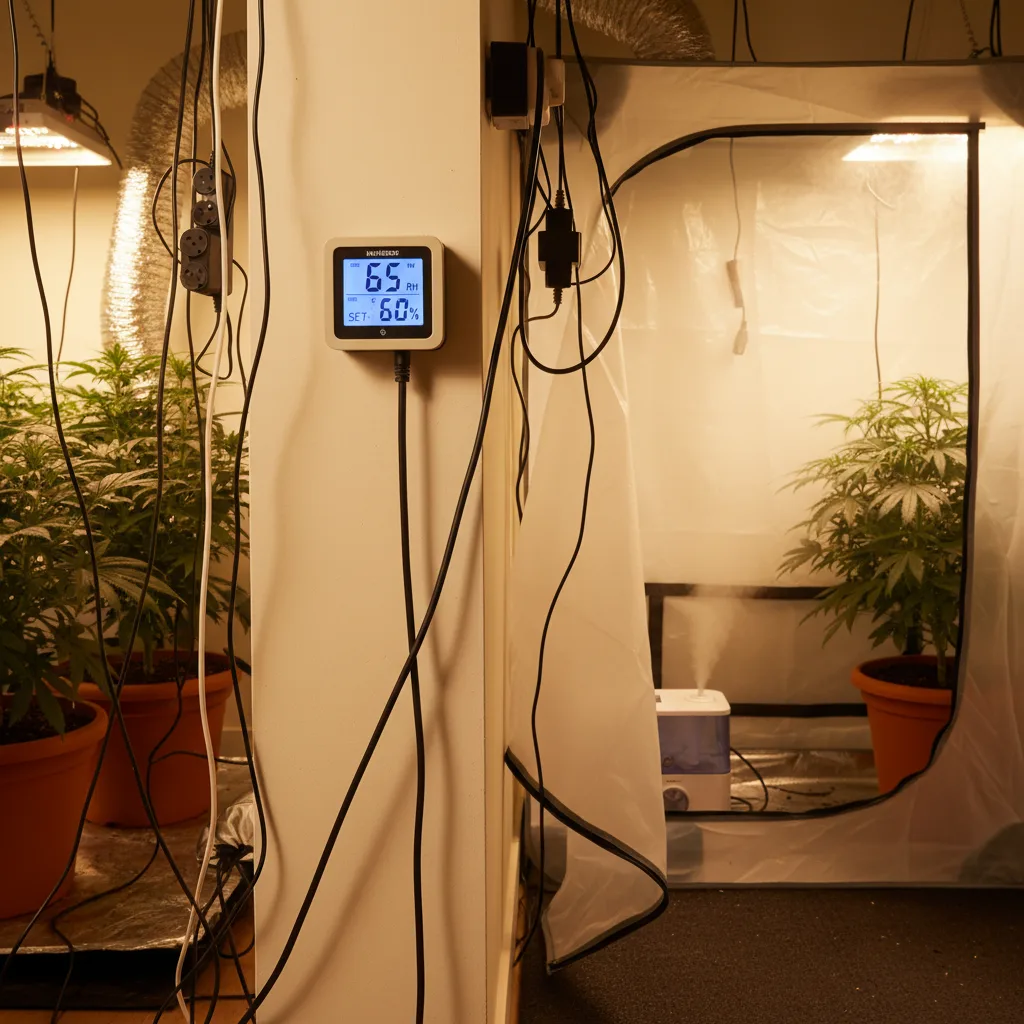
Humidity is the make-or-break variable in mushroom fruiting. Too low and your pins abort, caps crack, and yields plummet. Too high and you get pooling water, bacterial blotch, and conditions that favour contamination. The sweet spot for most gourmet species is 85-95% relative humidity, maintained consistently, 24 hours a day.
You can achieve this by hand-misting your fruiting chamber several times a day. We've done it. It works, for about a week, until you forget a misting, or leave for the weekend, or simply get tired of the routine. Automation solves this permanently.
A humidity controller plugs into your humidifier and cycles it on and off to maintain your target humidity. You set the number, and the controller does the rest. It's one of those upgrades that, once you have it, you can't imagine going back.
We've been running Inkbird controllers in our Martha tents and grow rooms for years. They dominate this product category for good reason, and every controller in this review is from Inkbird because, frankly, nobody else makes a better option at these levels.
This post contains affiliate links. When you buy through our links, it supports our mycology work at no extra cost to you.
Quick Verdict
The Inkbird IHC-200 WiFi is our pick for most growers. The WiFi connectivity lets you monitor and adjust from your phone, which is genuinely useful when you're away from your grow space. If you don't need WiFi, the standard IHC-200 does the same job for less. And if you want to control both temperature and humidity from one device (ideal for Martha tent setups), the ITC-608T combines both functions.
Comparison at a Glance
| Feature | IHC-200 WiFi | IHC-200 Standard | ITC-608T |
|---|---|---|---|
| Controls | Humidity only | Humidity only | Temp + Humidity |
| WiFi / App | Yes | No | No |
| Outlets | 2 (humidify / dehumidify) | 2 (humidify / dehumidify) | 4 (heat/cool/humidify/dehumidify) |
| Max Load | 15A / 1800W | 15A / 1800W | 15A / 1800W |
| Display | LED | LED | LED |
| Best For | Most growers | Budget setup | Martha tent (all-in-one) |
Our Pick: Inkbird IHC-200 WiFi
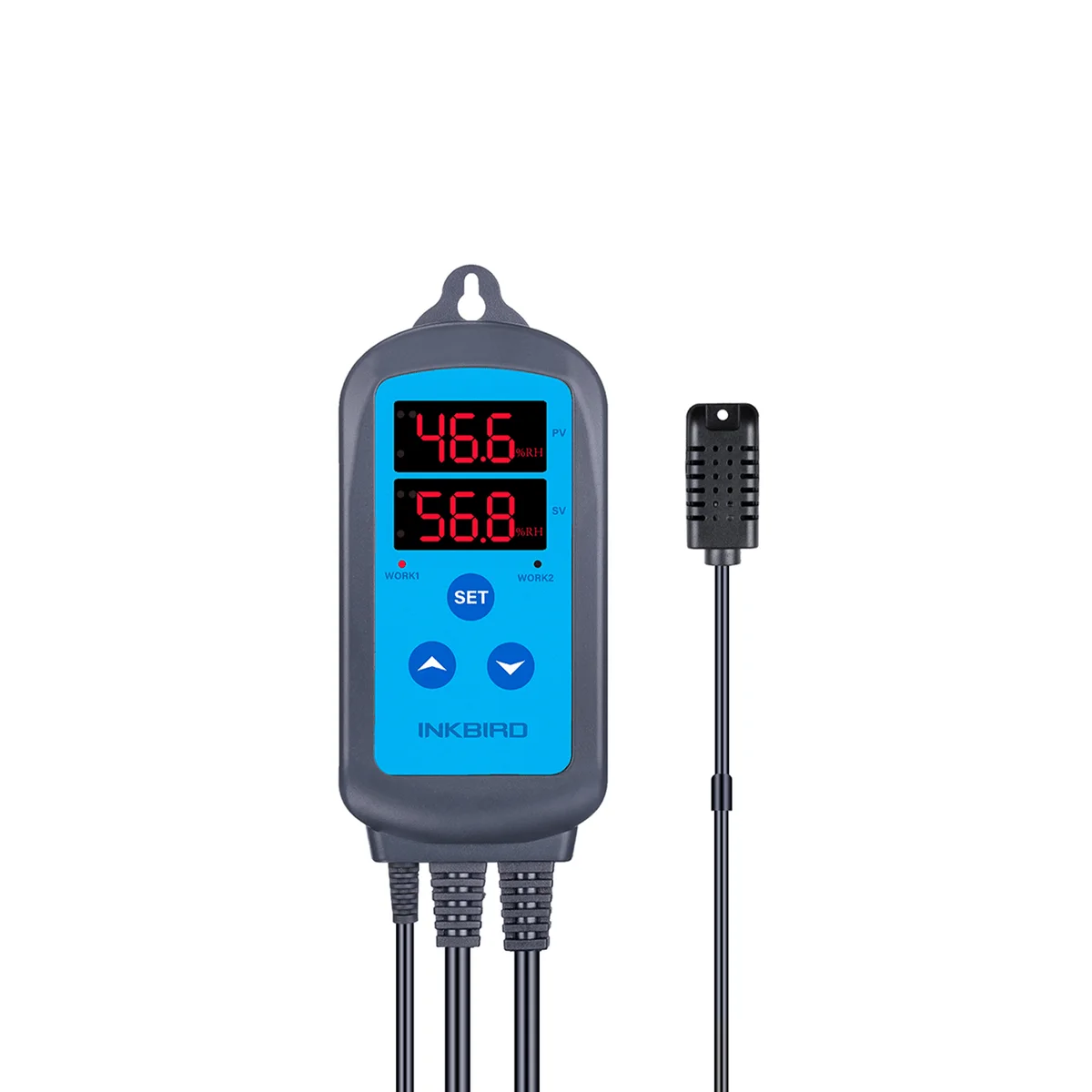
The IHC-200 WiFi is the controller we recommend to every serious mushroom grower. It does one thing extremely well: it keeps your humidity where you want it, and it lets you check on it from anywhere.
What We Like
WiFi monitoring and control. This is the feature that justifies the step up from the standard model. Open the Inkbird app on your phone and you can see the current humidity, adjust the set point, check the history, and get alerts if humidity drops below your threshold. When you're at work or away for the weekend, this peace of mind is worth the small premium.
Dual outlet design. One outlet powers your humidifier (turns on when humidity drops below set point), the other powers a dehumidifier or exhaust fan (turns on when humidity rises above set point). For mushroom growing, you'll primarily use the humidification outlet, but having the dehumidification outlet available means you can set up a complete humidity control loop.
Calibration function. The sensor can be calibrated against a known reference. Over time, humidity sensors drift slightly. Being able to recalibrate without replacing the sensor extends the useful life of the controller.
Pre-wired and plug-and-play. No electrical work needed. Plug the controller into the wall, plug your humidifier into the controller's outlet, hang the sensor probe in your fruiting chamber, set your target humidity, and you're done. Total setup time is about 5 minutes.
What Could Be Better
WiFi setup can be finicky. The initial app pairing process requires your phone and the controller to be on the same 2.4 GHz WiFi network. If your router broadcasts 5 GHz and 2.4 GHz on the same SSID, the app can have trouble finding the device. It's a one-time annoyance, but it's worth mentioning.
No temperature control. The IHC-200 only controls humidity. If you also need to manage temperature in your fruiting space (and you probably do during Canadian winters or summers), you'll need a separate temperature controller or upgrade to the ITC-608T.
Humidity sensor is not waterproof. The sensor probe needs to be in the humid environment of your fruiting chamber, but it can't be submerged or hit with direct mist spray. Position it carefully away from the humidifier output to get accurate readings and avoid damage.
Inkbird IHC-200 WiFi Humidity Controller
The humidity controller we recommend to every serious grower. WiFi lets you monitor and adjust from your phone, dual outlets handle both humidification and dehumidification, and setup takes 5 minutes. Set it and forget it.
When you buy through our links, it supports our mycology research at no extra cost to you.
Budget Pick: Inkbird IHC-200 (Standard, No WiFi)
If you don't need the WiFi connectivity and you're always near your grow space anyway, the standard IHC-200 does the exact same job for less. The controller itself is identical; you're just losing the app connectivity.
What We Like
Identical performance. Same sensor, same relay, same control logic. The humidity control is just as accurate and reliable as the WiFi version. Your mushrooms don't know the difference.
Lower cost. The savings compared to the WiFi version is meaningful, especially if you're buying multiple controllers for separate fruiting chambers or tents.
Simpler setup. No app to download, no WiFi to configure. Plug it in, set the humidity, go. There's something to be said for a device that has zero connectivity and therefore zero connectivity problems.
Same dual outlets. You still get the humidification and dehumidification outlets, giving you the same control options as the WiFi model.
What Could Be Better
No remote monitoring. The tradeoff is obvious. You can only see the current humidity and adjust settings when you're physically standing in front of the controller. If you're away from home and worried about your fruiting chamber, you have no way to check.
No data logging. The WiFi version stores history in the app. The standard version doesn't. If you like to review humidity trends over time to optimize your setup, you'll need a separate data logger.
Inkbird IHC-200 Humidity Controller (Standard)
Does exactly the same job as the WiFi version, you just can't check it from your phone. If you're always near your grow space and want to save on the controller, this is the smart budget move.
When you buy through our links, it supports our mycology research at no extra cost to you.
All-in-One Pick: Inkbird ITC-608T (Temp + Humidity)
One device that replaces two. The ITC-608T controls temperature AND humidity simultaneously, making it the ideal controller for a Martha tent where you need to manage both variables.
This is the controller that makes a Martha tent truly hands-off. You set your target temperature and humidity, plug in your heater, cooler, humidifier, and dehumidifier (or whatever combination you need), and the ITC-608T manages everything.
What We Like
Four outlets. Heating, cooling, humidification, and dehumidification each get their own outlet. In a typical Martha tent setup, you'd plug a small heater into the heating outlet and your ultrasonic humidifier into the humidification outlet. The controller cycles each independently based on its sensor readings.
12-period time staging. You can program different temperature and humidity targets for different times of day. This is useful for simulating natural conditions where nighttime temperatures drop slightly, which triggers pinning in some species. Most growers don't use this feature, but it's there for fine-tuning.
Single probe, dual measurement. The combined temperature/humidity sensor means one probe cable running into your fruiting chamber instead of two. Less clutter, simpler installation.
ETL safety listed. The ITC-608T is ETL certified, meaning it's been independently tested for electrical safety. When you're plugging 1800W of devices into a controller that runs 24/7, safety certification matters.
What Could Be Better
No WiFi. Despite being Inkbird's most capable mushroom-relevant controller, the ITC-608T lacks WiFi and app control. You need to be physically present to check readings and make adjustments. Given that this controller costs more than the IHC-200 WiFi, the lack of connectivity feels like a missed opportunity.
More complex setup. Four outlets, two control modes, and time staging means there are more settings to configure. It's not difficult, but it takes longer to set up compared to the single-purpose IHC-200.
Humidity sensor isn't waterproof. Same limitation as the IHC-200. The sensor probe needs to be positioned away from direct mist output.
Inkbird ITC-608T Temperature & Humidity Controller
One device replaces two. Controls heating, cooling, humidification, and dehumidification from a single unit. Perfect for a Martha tent where you need automated control over both temperature and humidity.
When you buy through our links, it supports our mycology research at no extra cost to you.
How to Choose
Martha tent with both temp and humidity needs? The ITC-608T is your one-stop solution. One device, four outlets, complete environmental control.
Monotub or simple fruiting chamber? The IHC-200 (WiFi or standard) is all you need. Pair it with one of our mushroom grow kits and you have a complete automated setup. Monotubs are generally self-regulating on temperature if they're in a climate-controlled room, so humidity is the only variable you're automating.
Do you travel or work away from home? The WiFi version gives you peace of mind. Being able to check your fruiting chamber humidity from your phone while you're at work is genuinely useful, not just a gimmick.
Running multiple chambers? Buy standard IHC-200 units for each chamber. The savings per unit adds up when you're buying 3-4 controllers, and the lack of WiFi matters less when you're walking past each chamber daily anyway.
Setup Tips
Regardless of which controller you choose, these tips will help you get the best results:
Sensor placement matters. Put the humidity sensor at mushroom level, not at the top of the chamber (where humidity is naturally higher) or the bottom (where it pools). The sensor should read the conditions your mushrooms actually experience.
Keep the sensor away from the humidifier output. If mist blows directly onto the sensor, it reads artificially high and won't trigger the humidifier when the rest of the chamber is actually dry. We position our sensors on the opposite side of the chamber from the mist input.
Set a reasonable differential. Most Inkbird controllers let you set a differential (the gap between the turn-on and turn-off points). A 3-5% differential works well. Too tight (1%) and the humidifier cycles on and off constantly. Too wide (10%) and humidity swings are noticeable.
Use an ultrasonic humidifier. The controllers are designed to work with devices that turn on and off cleanly with power cycling. Ultrasonic humidifiers respond instantly to power on/off. Evaporative humidifiers have a warm-up time and may not respond well to rapid cycling.
What Temperature Do Mushrooms Need?
Humidity is only half of the environmental equation. Different species fruit best at different temperatures, and getting both humidity and temperature right is what produces those magazine-quality flushes. Check our complete guide to mushroom growing temperatures for species-specific recommendations.
Frequently Asked Questions
What humidity level should I set for mushroom fruiting?
Most gourmet species fruit best at 85-95% relative humidity. Oyster mushrooms are tolerant and fruit well at 80-90%. Lion's mane prefers 90-95%. Start at 90% and adjust based on how your mushrooms respond. If caps are cracking, raise the humidity. If you're seeing excess moisture or bacterial issues, lower it.
Can I use a timer instead of a humidity controller?
You can, and some growers do. A timer that cycles your humidifier for 5 minutes on / 15 minutes off can maintain reasonable humidity in a sealed chamber. But it's a less precise approach, because the right cycle time changes with ambient conditions, season, and how many blocks are in the chamber. A humidity controller maintains your target regardless of these variables.
How long do Inkbird controllers last?
We've been running ours for 3+ years with no issues. The controller itself is solid-state electronics with no moving parts, so there's not much to wear out. The humidity sensor may need recalibration over time, and replacement sensors are available from Inkbird.
Related Guides
- Martha Tent Setup Guide
- Monotub Fruiting Chamber Guide
- What Temperature Do Mushrooms Need?
- Essential Mushroom Growing Equipment Guide
- How to Grow Oyster Mushrooms
- How to Grow Lion's Mane
- Mushroom Grow Kits — everything you need to start fruiting
Not sure which setup is right for you? Dr. MycoThumb is our free AI growing assistant — ask about equipment recommendations, growing setups, and troubleshooting. Available 24/7 in the chat bubble at the bottom-right of every page.