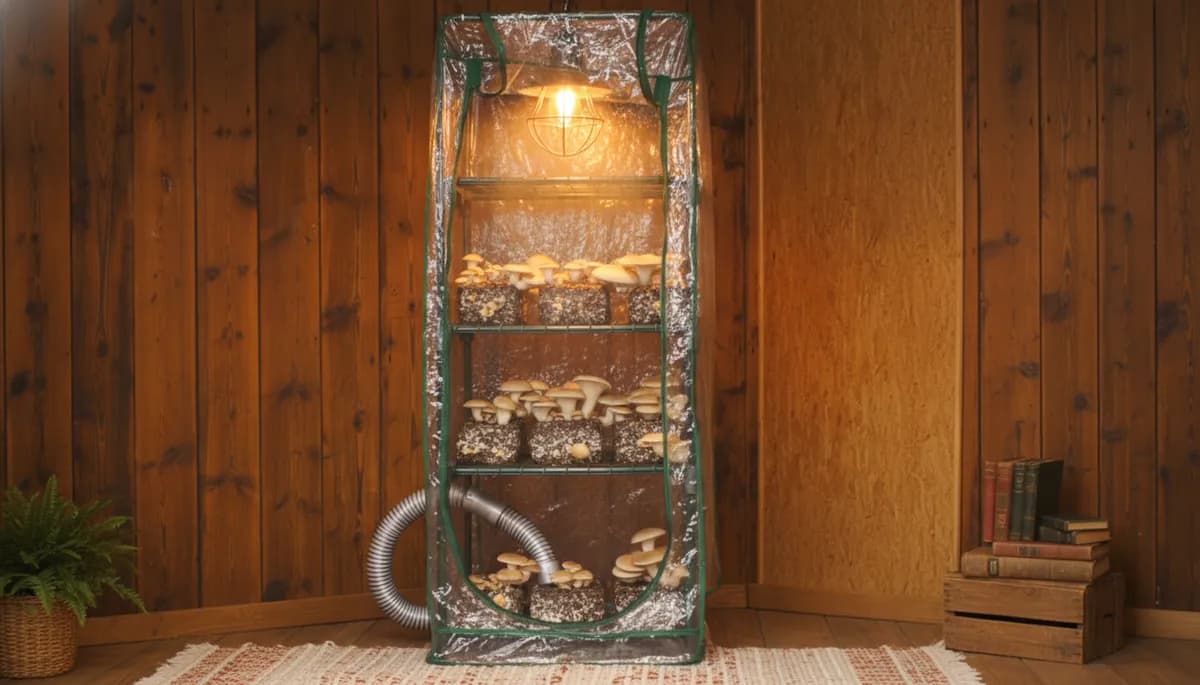
If you've outgrown your first mushroom grow kit and you're ready to produce serious quantities of fresh mushrooms at home, a Martha tent is the next step. Named after the Martha Stewart-style mini greenhouse it's based on, a Martha tent is a controlled fruiting chamber that gives you precise control over humidity, fresh air exchange, and temperature — the three factors that determine whether your mushrooms thrive or struggle.
A well-built Martha tent can fruit 6-12 blocks simultaneously, producing kilograms of fresh mushrooms every week. It's the setup that bridges the gap between casual hobbyist and dedicated home grower, and it's also the starting point for many small commercial farms.
This guide walks you through the complete build, from parts list to first harvest.
Why a Martha Tent?
You might be wondering why you need a dedicated fruiting chamber at all. Can't you just cut your bags open and mist them on the kitchen counter?
You can — and for a single grow kit, that works fine. But as soon as you're running multiple blocks, the limitations of open-air fruiting become apparent:
Humidity consistency. Mushrooms need 80-95% relative humidity during fruiting. Your kitchen is probably sitting at 30-40%. Misting helps, but it creates spikes and valleys rather than the consistent environment mushrooms prefer. A Martha tent maintains high humidity continuously.
Contamination control. An enclosed space limits exposure to airborne contaminants. This matters less during fruiting (the mycelium is already established) than during colonization, but it still helps.
Space efficiency. A Martha tent uses vertical space with shelves, allowing you to fruit many more blocks in the same floor footprint. A single tent in a corner of your basement can produce more mushrooms than most families can eat.
Scalability. Everything you learn running a Martha tent translates directly to a larger grow room. The principles are identical — you're just controlling them in a smaller space.
Parts List
Here's everything you need, with estimated costs in Canadian dollars.
The Tent
| Item | Estimated Cost | Notes |
|---|---|---|
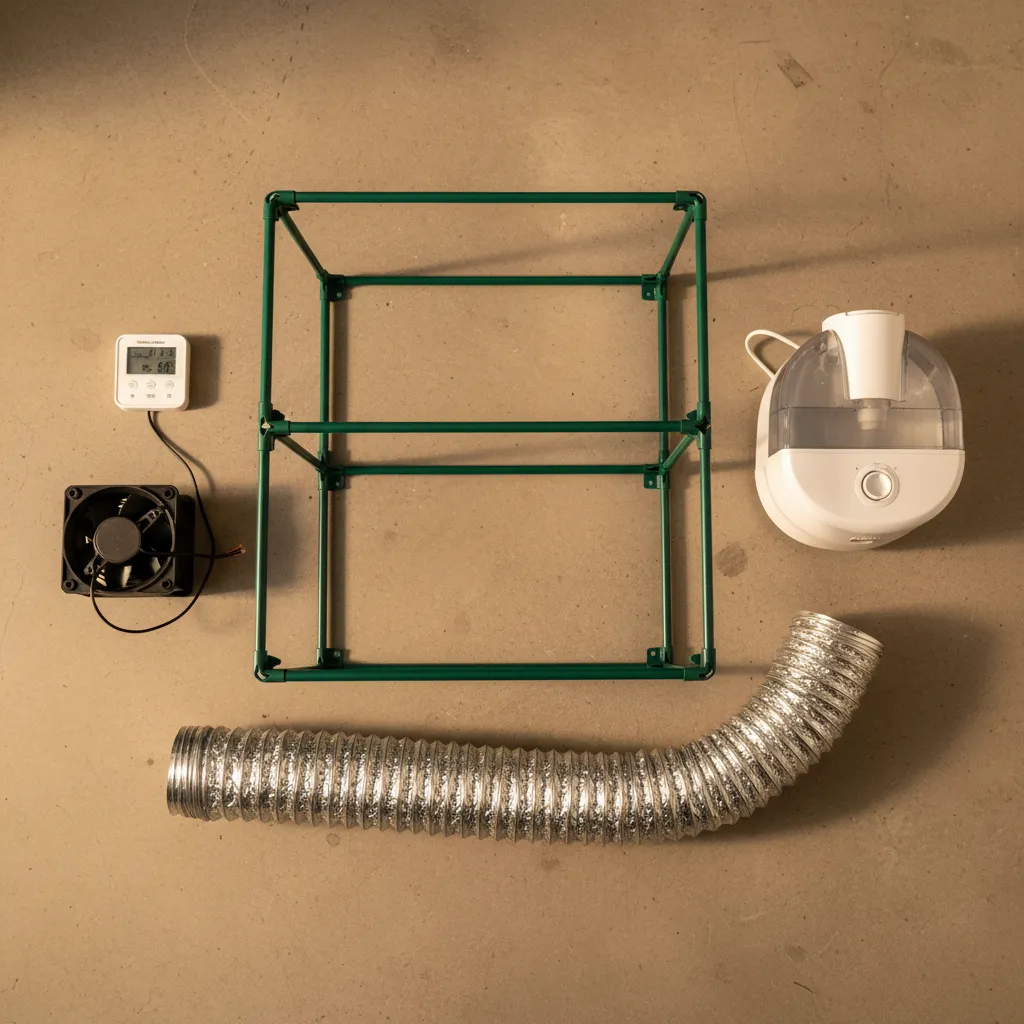
| 4-shelf mini greenhouse / grow tent | $40-80 | The "Martha" itself. Available at Canadian Tire, Home Depot, or online. Look for one with a clear PVC or plastic zip-up cover and wire shelving. Dimensions around 60 cm wide x 45 cm deep x 130-160 cm tall. |
| Replacement clear PVC cover (optional) | $15-25 | Some cheap greenhouses come with flimsy covers. A thicker replacement improves humidity retention. |
Humidity System
| Item | Estimated Cost | Notes |
|---|---|---|
| Ultrasonic disc humidifier | $15-30 | A single-disc or dual-disc ultrasonic mist maker that sits in a reservoir of water. Available on Amazon. Do NOT use a warm mist / evaporative humidifier — ultrasonic is essential. |
| Plastic tub or bucket (reservoir) | $5-10 | The humidifier disc sits in water inside this container. A 10-20 litre plastic tub works well. |
| Flexible ducting (7.5-10 cm / 3-4 inch) | $10-20 | Runs from the reservoir to the tent, carrying mist inside. |
| PVC or duct tape | $5-10 | For sealing connections. |
Automation
| Item | Estimated Cost | Notes |
|---|---|---|
| Humidity controller (Inkbird IHC-200 or similar) | $40-60 | Plugs your humidifier into a controller that turns it on and off based on a set humidity level. This is what makes the system hands-off. |
| Humidity/temperature sensor | Included | Most controllers come with a sensor probe. |
| Timer (optional) | $10-15 | For cycling the humidifier if you don't have a humidity controller. A simple 15-minute interval timer works. |
Air Exchange
| Item | Estimated Cost | Notes |
|---|---|---|
| Small fan (computer fan or USB fan) | $10-20 | Provides gentle air circulation. A 12V computer fan is ideal — quiet and low-power. |
| Timer or fan speed controller | $10-15 | To cycle the fan on and off (you don't want constant airflow — just periodic exchange). |
Optional but Helpful
| Item | Estimated Cost | Notes |
|---|---|---|
| Thermometer/hygrometer | $10-20 | A secondary readout so you can monitor conditions at a glance without relying solely on the controller. |
| LED strip light | $10-15 | Mushrooms need a small amount of light to orient their growth. A basic LED strip on a timer (12 hours on / 12 hours off) is sufficient. Natural indirect light also works if the tent is near a window. |
| Drip tray | $5-10 | Goes on the bottom shelf to catch excess moisture. |
Total estimated cost: $170-330 CAD
That's less than the cost of buying fresh gourmet mushrooms for a few months — and this setup will produce mushrooms continuously for years.
Mushroom Growing Tent (Martha Tent)
Purpose-built Martha tent for mushroom fruiting — comes with clear PVC cover, 4-tier shelving, and zipper access. Fits monotubs inside and has ports for ducting. Much sturdier than a basic greenhouse frame.
View on Amazon.ca →When you buy through our links, it supports our mycology research at no extra cost to you.
Step-by-Step Assembly
Step 1: Assemble the Greenhouse Frame
Follow the manufacturer's instructions to assemble the wire shelving unit. Most mini greenhouses click together without tools. Position the shelves with enough vertical space between them for your mushroom blocks to fruit — 25-35 cm between shelves is usually right. Remove shelves you don't need to create the spacing that works for your blocks.
Place the frame in its permanent location before adding the humidity system. A basement, spare room, or garage works well. Avoid direct sunlight — it heats the tent and promotes algae growth. You want indirect light or artificial light only.
Step 2: Set Up the Humidity Reservoir
Place your plastic tub next to (or behind) the tent. Fill it with clean water and place the ultrasonic disc humidifier in the water according to its instructions. The disc should be submerged at the depth recommended by the manufacturer — usually 3-5 cm of water over the disc.
Important: Use clean, cold water. Hot water damages ultrasonic discs. Some growers use distilled water to prevent mineral buildup (the white dust that ultrasonic humidifiers produce from mineral-rich tap water). If your tap water is very hard, distilled or reverse-osmosis water is worth the extra cost.
Step 3: Run the Ducting
Connect flexible ducting from the top of the reservoir tub to an opening in the tent. You can cut a small hole in the PVC cover of the tent, or route the ducting through the zipper opening. Seal the connection with duct tape to prevent mist from escaping.
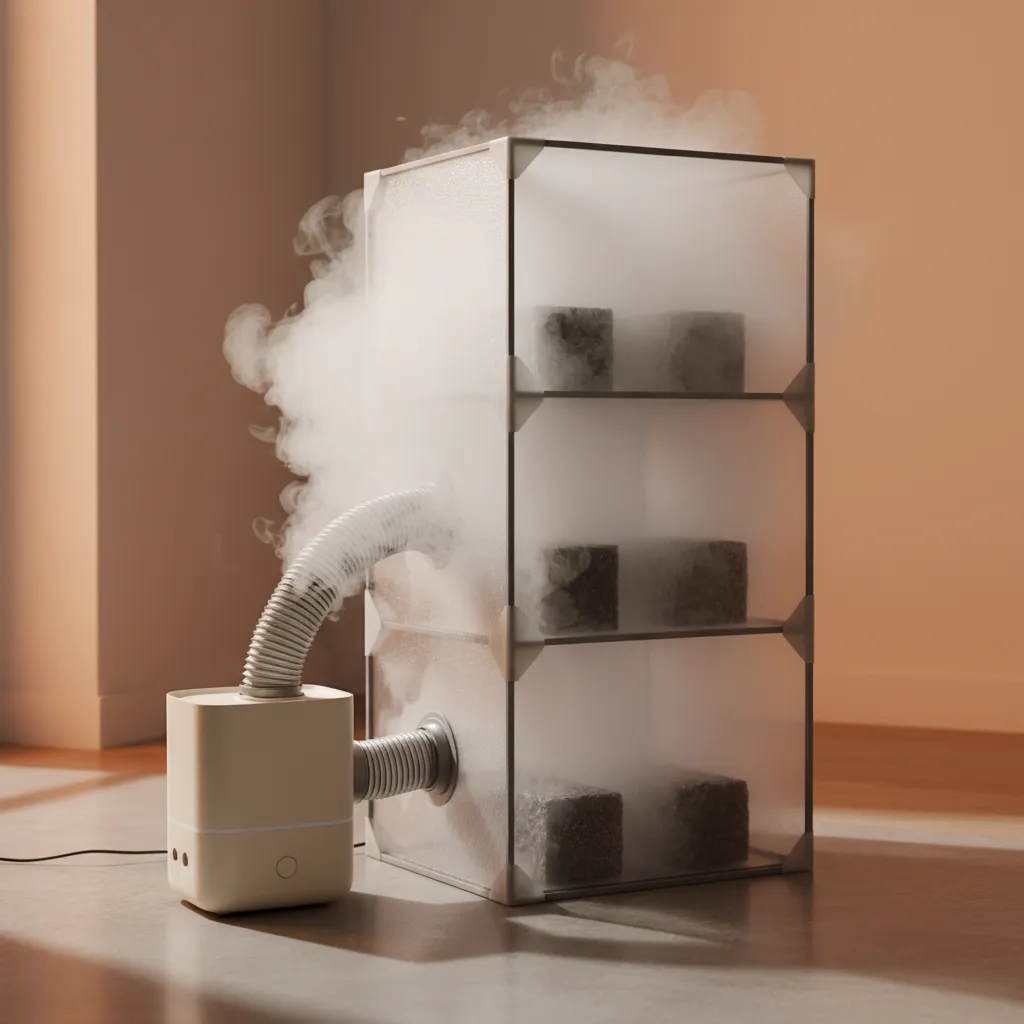
The mist should enter the tent at the top or upper-middle level and drift downward over the blocks. Gravity will help distribute the humidity evenly. Some growers add a small computer fan at the end of the ducting inside the tent to help distribute the mist — this is optional but helpful in larger setups.
Step 4: Wire the Humidity Controller
Plug the ultrasonic humidifier into the humidity controller's outlet. Place the controller's sensor probe inside the tent, at shelf level (not at the very top or bottom — you want a reading that represents conditions where your blocks are).
Set the controller to:
- Target humidity: 90%
- Differential: 3-5% (the humidifier turns on when humidity drops to 85-87% and off when it reaches 90%)
The controller will now automatically maintain your target humidity by cycling the humidifier on and off. This is the single most important piece of the setup — it's what makes a Martha tent a reliable, hands-off system rather than a constant babysitting project.
Step 5: Set Up Air Exchange
Fresh air exchange (FAE) is essential. Mushrooms respire — they consume oxygen and produce CO2, just like we do. Without FAE, CO2 builds up inside the tent, which causes long, leggy stems and small caps. But too much FAE drops humidity rapidly. The balance is the art of running a Martha tent.
Method 1: Passive FAE. Leave the bottom of the tent cover slightly open (unzipped 5-10 cm). Warm, humid air rises and exits through gaps at the top; fresh air enters from the bottom. This works well in moderate climates but may not provide enough exchange for a fully loaded tent.
Method 2: Active FAE. Mount a small fan on a timer. Run it for 5-10 minutes every 1-2 hours to exchange air in the tent. The fan can blow air into the tent (pushing out stale air through gaps) or exhaust air out of the tent (pulling fresh air in through gaps). Either works.
Method 3: Humidity-driven FAE. When the humidifier runs, the mist flowing through the ducting pushes fresh air into the tent. If your humidifier cycles frequently enough, this alone can provide adequate FAE. Monitor CO2 levels or mushroom morphology (see Troubleshooting) to determine if additional FAE is needed.
Step 6: Add Lighting
Mount an LED strip light inside the tent or position the tent where it receives indirect natural light. Mushrooms don't photosynthesize, but they do use light as a directional signal — they grow toward light sources. Without any light, mushrooms grow in random directions and may develop abnormal shapes.
A simple timer running the light for 12 hours on / 12 hours off mimics a natural day/night cycle and is more than sufficient.
Step 7: Test the System
Before loading your blocks, run the tent empty for 24 hours. Monitor:
- Humidity (should hold steady at your target, 85-95%)
- Temperature (should stay in range for your species)
- Condensation (some is normal, but heavy dripping means humidity is too high or FAE is too low)
- Noise (ultrasonic humidifiers are quiet, but check that the fan isn't rattling)
Adjust your controller settings, FAE timing, and ducting position based on what you observe.
Species Recommendations
Different mushroom species have different environmental preferences. Here's how common species perform in a Martha tent, with temperature guidance.
Best for Martha Tents
Blue Oyster — The easiest species to fruit in a Martha tent. Tolerates a range of conditions, fruits at 10-21°C (50-70°F), and produces fast, heavy flushes. If this is your first Martha tent grow, start here. Blue Oyster spawn | Blue Oyster grow kit
Lion's Mane — Thrives in high humidity, which makes the Martha tent an ideal environment for this species. Fruits at 15-20°C (59-68°F). Slightly more particular than oysters about humidity consistency — the Martha tent's automated humidity solves this perfectly. Lion's Mane grow kit
Pink Oyster — A great summer species for the Martha tent if your growing space is warm. Needs 18-30°C (64-86°F). Grows explosively fast in humid conditions — expect pins within days.
Shiitake — Fruits well in a Martha tent at 10-21°C (50-70°F). Benefits from the consistent humidity that's hard to maintain with open-air fruiting. For more on shiitake cultivation, see how to grow shiitake mushrooms.
More Challenging
King Oyster — Needs lower humidity (75-85%) and cooler temperatures (12-18°C / 54-64°F) than most species. Can work in a Martha tent with adjusted controller settings, but requires more attention.
Reishi — Grows well but produces heavy spore loads that coat everything in brown powder. Some growers dedicate a separate tent to reishi for this reason.
Troubleshooting
Problem: Long, Leggy Stems with Tiny Caps
Cause: Not enough fresh air exchange. High CO2 levels cause mushrooms to stretch toward oxygen sources, producing elongated stems and undersized caps.
Fix: Increase FAE. Open the bottom of the tent cover wider, increase fan runtime, or add a second air exchange cycle. This is the single most common Martha tent issue, and it's always the same fix: more fresh air. For more on temperature and environmental management, see our guide on what temperature do mushrooms need.
Problem: Humidity Won't Stay Above 80%
Cause: Too much air exchange, tent cover has gaps or tears, or the humidifier isn't producing enough mist.
Fix: Check the tent cover for holes or unsealed zippers. Reduce FAE slightly — there's always a balance between humidity and fresh air. If the humidifier is the bottleneck, consider upgrading to a dual-disc unit or adding a second humidifier. Also check the water level in the reservoir — the disc must be submerged to function.
Problem: Puddles of Water on Shelves or Floor
Cause: Humidity is too high (above 95%) or there's not enough airflow to distribute moisture evenly. Condensation forms on surfaces and pools.
Fix: Lower your humidity target to 85-90%. Add a small circulating fan inside the tent (not blowing directly on blocks, just moving air gently). Add a drip tray on the bottom shelf. Some condensation is normal and unavoidable — puddles are excessive.
Problem: Green Mold on Blocks or Shelves
Cause: Trichoderma contamination, the most common mold in mushroom growing. It thrives in warm, humid environments — exactly the conditions you're creating in a Martha tent.
Fix: Remove contaminated blocks immediately — Trichoderma spreads fast. Clean the tent and shelves with a 10% bleach solution or isopropyl alcohol (we keep a 4L jug on hand at all times). Check that your blocks were properly colonized before entering the tent (fully white, no bare spots). Green mold on blocks that aren't fully colonized means the colonization step failed, not the Martha tent. For a deep dive into contamination, read green mold and mushroom contamination.
Problem: Mushrooms Growing Towards One Side
Cause: Uneven light distribution. Mushrooms orient their growth toward light, so if light enters from one side, they'll all lean that way.
Fix: Add an LED strip inside the tent for even illumination, or rotate blocks periodically.
Problem: No Pins After a Week
Cause: Several possibilities — blocks aren't fully colonized, humidity is too low, temperature is out of range for the species, or there's no light trigger.
Fix: Verify full colonization (the block should be completely white with no visible uncolonized substrate). Check humidity is above 80%. Verify temperature is in range for your species. Ensure there's at least some indirect light reaching the blocks. If growing oyster mushrooms from bags, make sure you've cut the bags open — they need an opening to fruit from. Read how to grow oyster mushrooms for species-specific fruiting guidance.
Maintenance
A Martha tent requires light but consistent maintenance to keep it running well.
Daily:
- Check humidity and temperature readings
- Refill the humidifier reservoir as needed (daily in dry conditions)
- Quick visual check of blocks for signs of contamination
Weekly:
- Wipe down shelves and interior surfaces to prevent algae and mold buildup
- Clean the ultrasonic disc (mineral deposits reduce mist output over time)
- Check ducting connections for looseness
Between Grows:
- Remove all spent blocks
- Clean the entire tent, shelves, and cover with a diluted bleach or hydrogen peroxide solution
- Clean the humidifier reservoir and disc thoroughly
- Inspect the tent cover for tears or worn spots
Scaling Beyond the Martha Tent
Many growers start with a Martha tent and eventually outgrow it. The natural next step is a dedicated fruiting room — a small, enclosed room (a closet, spare bathroom, or purpose-built space) with a humidifier, exhaust fan, and fresh air intake. The principles are identical to a Martha tent, just on a larger scale.
If you're considering turning your hobby into a business, our guide on how to start a mushroom farm in Canada covers the full journey from first tent to first farmers' market.
A Martha tent is one of those projects where the setup effort pays off immediately and continuously. Once it's built and dialled in, you've got a miniature mushroom farm running in a corner of your basement — producing fresh gourmet mushrooms every week with just a few minutes of daily attention.
Start with a grow kit or grain spawn and a bag of substrate, load up your tent, and watch the magic happen. Browse our growing supplies for everything you need to get your Martha tent producing.
Need help with your grow? Dr. MycoThumb is our free AI growing assistant — ask about substrates, contamination, fruiting conditions, or any cultivation question. Available 24/7 in the chat bubble at the bottom-right of every page.