One of the most common questions we get from new growers is "how long does this take?" The honest answer is: it depends on the species, your method, and your conditions. But we can give you a detailed week-by-week breakdown that covers the three most popular gourmet species so you know exactly what to expect — and more importantly, what's normal versus what's a problem.
This timeline covers the full journey from grain spawn inoculation through harvest. If you're growing from a grow kit, you can skip ahead to the fruiting section — most of the colonization work has been done for you.
The Three Species
We're tracking three species through their full lifecycle:
- Oyster Mushrooms (Blue Oyster) — the fastest and most forgiving
- Shiitake — the patient grower's reward
- Lion's Mane — unique and increasingly popular
All timelines assume:
- Inoculation from liquid culture or agar into grain spawn
- Colonization at 21-24°C (70-75°F)
- Fruiting in a monotub, Martha tent, or similar fruiting chamber with a hygrometer to track conditions
- Reasonable sterile technique (working in a SAB or flow hood)
Phase 1: Grain Spawn Colonization
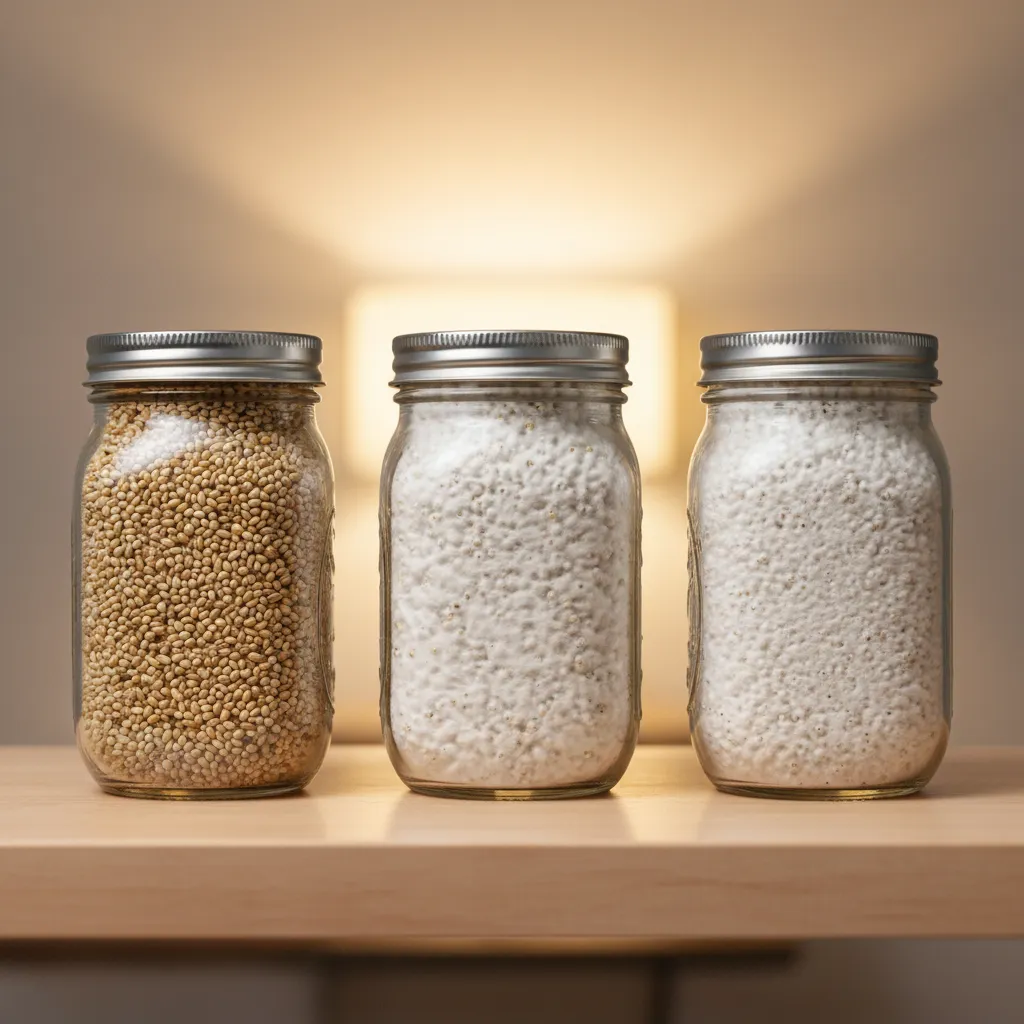
This phase begins when you inoculate your sterilized grain and ends when the grain jar is fully colonized — every kernel covered in white mycelium.
Week 1: Inoculation and Early Growth
What you did: Inoculated sterilized grain jars or bags with liquid culture, agar wedge, or grain-to-grain transfer.
What you see:
- Days 1-3: Nothing visible. The mycelium is germinating from the liquid culture or establishing from the agar wedge. This is completely normal. Do not assume failure at this stage.
- Days 4-7: Small white spots appear at the inoculation points. These are tiny — sometimes just a thin ring of white around a single grain. You might need to look closely.
What's normal: No visible growth for the first 3-5 days. Some species and some cultures take longer to establish. Temperature has a major effect here — at 18°C (64°F), you might not see anything for a full week.
What's concerning: Green, blue-green, or black spots appearing within the first week usually mean contamination entered during inoculation. Review your sterile technique.
Species differences:
- Oyster: Often shows visible growth by day 3-4. Oyster mycelium is aggressive.
- Shiitake: Slower to start. May not show visible growth until day 5-7.
- Lion's Mane: Moderate. Usually visible by day 4-6. Lion's mane mycelium is wispy and can be harder to spot initially.
Week 2: Visible Colonization
What you see: White mycelium is now clearly spreading outward from each inoculation point. The patches grow visibly day by day.
Action item — The Break and Shake: When your jar reaches approximately 30% colonization, shake it vigorously to break up the colonized grain and redistribute it throughout the jar. This dramatically speeds up the remaining colonization. See our spawn making guide for details.
What's normal: Colonization speed varies between inoculation points in the same jar. Some spots grow faster than others — this is genetic variation, not a problem.
What's concerning: Large uncolonized zones that aren't progressing at all, especially if the grain in those areas looks wet, slimy, or discolored. This may indicate bacterial contamination (wet spot) in that section of the jar.
Species differences:
- Oyster: 40-60% colonized by end of week 2. After a break and shake, oyster can finish in days.
- Shiitake: 20-35% colonized. Shiitake is noticeably slower but steady.
- Lion's Mane: 25-40% colonized. Moderate pace, wispy white growth.
Weeks 3-4: Full Colonization
What you see: The jar approaches or reaches full colonization — every grain covered in white mycelium. The entire jar looks like a solid white mass.
What's normal: Some small patches of uncolonized grain visible through the glass, especially in the centre of the jar where you can't see well. Give it a few extra days (consolidation) after the surface looks fully colonized.
What's concerning: Large areas that remain uncolonized after 4 weeks (for oyster) or 6 weeks (for shiitake). This may indicate temperatures are too low, the culture was weak, or contamination is blocking growth.
Species differences:
- Oyster: Fully colonized by week 2-3. Ready for use after a few days of consolidation.
- Shiitake: May take the full 4 weeks or slightly longer. Don't rush it — shiitake benefits from thorough colonization.
- Lion's Mane: Typically fully colonized by week 3-4. The mycelium has a distinctive fluffy, tomentose appearance.
Phase 2: Bulk Substrate Colonization
This phase begins when you mix your colonized grain spawn into bulk substrate and ends when the substrate is fully colonized and ready for fruiting conditions.
Week 4-5 (from original inoculation): Spawning to Bulk
What you did: Mixed broken-up colonized grain spawn into prepared bulk substrate (CVG, hardwood, straw) in your monotub or fruiting container.
What you see:
- Days 1-3: Individual grains are visible in the substrate, but no mycelial growth is visible between them yet.
- Days 3-5: White spots appear around each grain, spreading into the surrounding substrate. Each grain becomes a little node of growth.
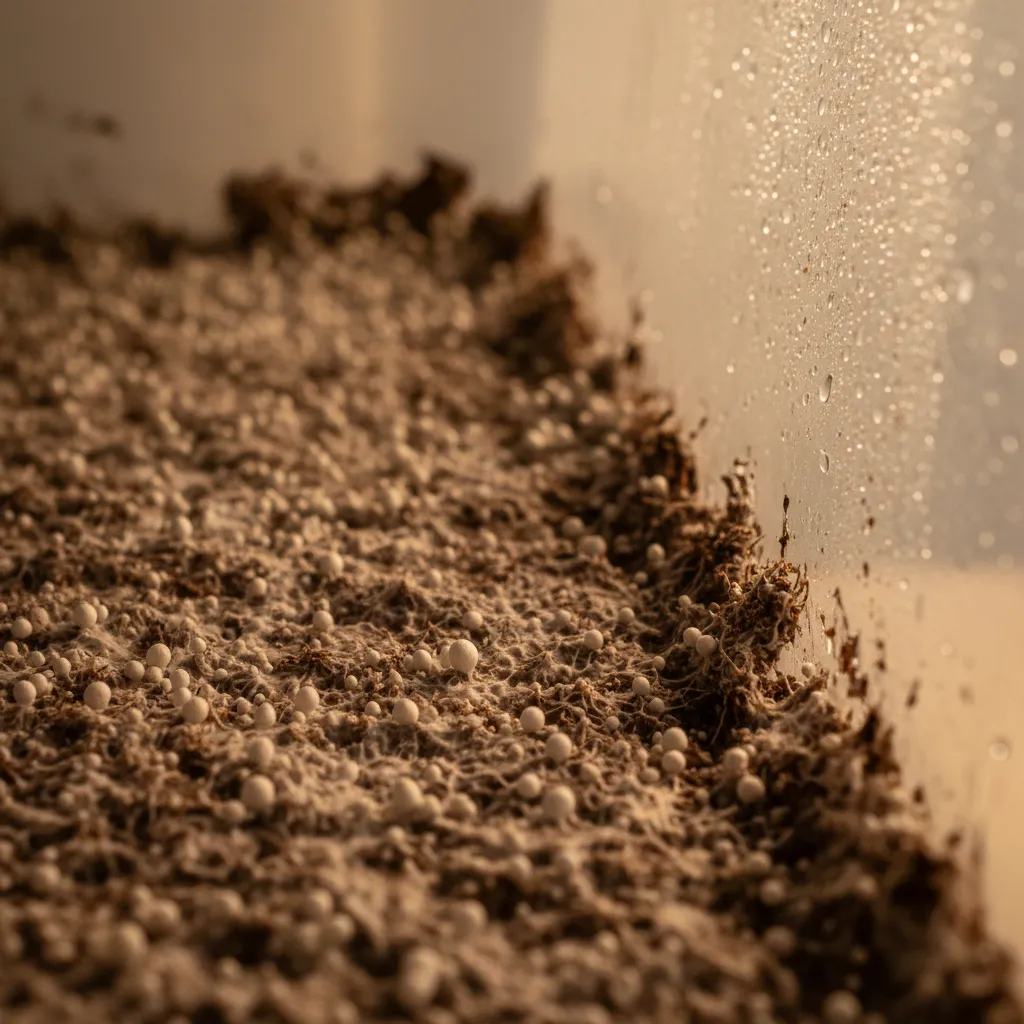
- Days 5-10: Growth nodes merge. The surface starts to look like a white patchwork quilt as mycelium fills the gaps between grain points.
What's normal: Uneven growth. Some areas colonize faster than others based on spawn distribution, moisture variation, and temperature gradients in the tub.
What's concerning: Green mold (Trichoderma) appearing during this phase. Trich on an uncolonized substrate is a death sentence for the batch — the mushroom mycelium can't compete.
Species differences:
- Oyster: Surface colonization in 7-10 days. Oyster is by far the fastest bulk colonizer.
- Shiitake: 14-21 days for bulk colonization. Shiitake is slower but thorough.
- Lion's Mane: 10-14 days. Moderate pace.
Week 5-7: Full Bulk Colonization
What you see: The entire substrate surface is covered in white mycelium. The substrate has a uniform white appearance when viewed from above. Through the clear tub walls, you can see mycelium penetrating several centimetres deep.
What's normal: The substrate may develop a slightly yellowish tinge in some areas — this is mycelial metabolites and is not contamination. You may also see hyphal knots (small dense bumps of mycelium) forming on the surface — these are early primordia and a great sign.
When to move to fruiting: When the surface is 75-100% colonized. Some growers wait for 100% coverage; others introduce fruiting conditions at 75%. Earlier introduction means faster pins but slightly higher contamination risk.
TempPro TP50 Digital Hygrometer & Thermometer
Knowing your exact temperature and humidity takes the guesswork out of troubleshooting slow colonization and pinning issues. The max/min records show you what happened overnight.
View on Amazon.ca →When you buy through our links, it supports our mycology research at no extra cost to you.
Phase 3: Fruiting
This phase begins when you introduce fruiting conditions (fresh air, light, temperature change) and ends at harvest.
Week 6-8: Pinning
What you did: Introduced fruiting conditions — increased fresh air exchange, added a 12/12 light cycle, possibly dropped temperature slightly. For a monotub, this means adjusting the lid or polyfill. For a Martha tent, adjusting humidifier and fan settings.
What you see:
- Days 1-3 of fruiting conditions: No visible change. The mycelium is receiving the environmental signals but hasn't responded yet.
- Days 3-7: Primordia (pins) form. These start as small dense bumps or knots on the mycelium surface, then rapidly develop into recognizable tiny mushroom shapes.
What's normal: Pins forming unevenly — more in some areas than others. Clustering near fresh air sources (holes, gaps in the lid) is common because the local CO2 is lower there.
What's concerning:
- No pins after 14 days of fruiting conditions: Check FAE (likely too low), humidity (may be too low — use a hygrometer to verify), temperature (may be too high or too low), and light. The most common cause is insufficient fresh air. See our temperature guide.
- Pins forming and then aborting (dying off): Often caused by inconsistent humidity or temperature swings. Pins are sensitive to environmental fluctuation.
Species differences:
- Oyster: Pins appear within 3-5 days of fruiting conditions. Oyster is aggressive and responsive.
- Shiitake: 7-14 days to pin. Shiitake benefits from a "cold shock" — a 24-hour drop to 10-15°C (50-59°F) can trigger pinning. Some growers soak the block in cold water overnight.
- Lion's Mane: 5-10 days to pin. Lion's mane pins look like small white pom-poms or nodules, which is distinct from the traditional "cap and stem" pin morphology of other species.
Week 7-10: Growth and Harvest
What you see: Pins develop rapidly into mature mushrooms. Growth is visible day by day — often hour by hour in the case of oyster mushrooms.
Harvest timing by species:
Oyster mushrooms: Harvest when the cap edges are still slightly curled or just flattening. From pin to harvest is typically 5-7 days in optimal conditions. Don't wait for the caps to fully flatten and upturn — by that point, the mushroom is past peak and dropping spores heavily.
Oyster mushrooms are the fastest from pin to harvest. In warm conditions with good humidity, Blue Oyster can go from visible pin to harvestable cluster in 4-5 days. Pink Oyster is even faster — sometimes 3-4 days.
Shiitake: Harvest when the cap is 70-80% open, with the edges still slightly curled inward. From pin to harvest is 7-14 days. Shiitake develops slowly compared to oyster but the flavour and texture are worth the wait. The cap should feel firm and meaty when pressed.
Lion's Mane: Harvest when the spines (teeth) are 0.5-1 cm long and the body is still white and firm. Before the edges start to yellow or brown. From pin to harvest is 7-10 days. Lion's mane looks like a white, fluffy snowball or waterfall of spines. It grows as a single mass rather than a cluster of caps.
Summary Timeline Table
| Milestone | Oyster | Shiitake | Lion's Mane |
|---|---|---|---|
| Grain spawn visible growth | Day 3-4 | Day 5-7 | Day 4-6 |
| Grain fully colonized | Week 2-3 | Week 4-5 | Week 3-4 |
| Bulk substrate colonized | Week 3-5 | Week 6-8 | Week 5-7 |
| Pins visible | Week 4-6 | Week 7-10 | Week 6-8 |
| First harvest | Week 5-7 | Week 8-12 | Week 7-9 |
| Second flush harvest | Week 7-9 | Week 11-15 | Week 9-12 |
Total time from inoculation to first harvest:
- Oyster: 5-7 weeks
- Lion's Mane: 7-9 weeks
- Shiitake: 8-12 weeks
What Affects Speed?
Temperature
Temperature is the single biggest factor in colonization and fruiting speed. Within the safe range for each species:
- Every degree warmer (up to the species' maximum) noticeably speeds colonization. Oyster mycelium at 27°C (80°F) colonizes nearly twice as fast as at 18°C (64°F).
- But warmer isn't always better. Higher temperatures also favour contamination. The sweet spot of 21-24°C (70-75°F) balances speed with safety.
- Fruiting temperatures are species-specific. Check our temperature guide for optimal fruiting ranges.
Spawn Rate
Higher spawn rates (more grain spawn per unit of substrate) mean faster colonization. A 1:2 spawn-to-substrate ratio colonizes roughly twice as fast as 1:4. For speed, use more spawn.
Spawn Generation
Fresh spawn from agar or liquid culture (G1) tends to colonize more vigorously than spawn that's been through multiple grain-to-grain transfers. If your colonization seems slow, check your spawn generation.
Genetics
Some strains within a species are simply faster than others. If you're cloning your fastest-colonizing fruits and selecting for speed, you'll see meaningful improvement over time.
Substrate
Some substrates colonize faster than others. Straw colonizes faster than hardwood sawdust for oyster mushrooms. CVG colonizes faster than dense supplemented sawdust. Check our substrate guide for details.
How to Know If Something Is Wrong
No growth after 10 days on grain: The culture may be dead, or temperatures are too low. Try moving to a warmer location (24-27°C / 75-80°F). If nothing after 3 weeks, start over.
Growth stalled at 50-70% on grain: Shake the jar to redistribute colonized grain. If growth doesn't resume within a week, there may be a contamination pocket blocking progress.
Surface colonization stopped on bulk: Temperature drop? Substrate too dry? Check both. Surface dryness can halt mycelial advance. A light mist of the surface (not soaking) may restart growth.
Pins forming but not maturing: Humidity is likely fluctuating. Developing mushrooms are very sensitive to changes in relative humidity. Maintain consistent 85-95% RH during fruiting. Also check for temperature swings.
Everything is growing but taking twice as long as expected: Check temperature first. Then check your spawn — old or weak spawn from too many transfers will colonize slowly. Consider starting with fresh cultures or spawn.
Grow Kit Timeline (Shortcut)
If you start with a grow kit instead of grain spawn, the colonization phases are already done for you. Here's the kit-specific timeline:
- Day 1: Open the kit, cut the bag, start misting.
- Days 3-7: Pins appear at the opening.
- Days 7-14: Mushrooms grow to harvest size.
- Days 14-21: First flush harvested, block soaked for second flush.
- Days 21-35: Second flush pins and develops.
A grow kit gets you from box to plate in as little as 10-14 days. It's the fastest path to fresh mushrooms and a great way to learn what fruiting mushrooms look and feel like before committing to the full grain-spawn-to-substrate process.
Understanding the timeline takes the anxiety out of growing. When you know that day 5 with no visible growth is perfectly normal, you stop worrying. When you know that oyster pins should appear within a week of fruiting conditions, you know when to start troubleshooting. Grow with patience, check our complete growing guide for the full picture, and trust the process.
Need help with your grow? Dr. MycoThumb is our free AI growing assistant — ask about substrates, contamination, fruiting conditions, or any cultivation question. Available 24/7 in the chat bubble at the bottom-right of every page.